
Her mom had a feeling during the pregnancy. Not a fear exactly — more like a quiet pull toward something she could not name. She found herself drawn to people with disabilities in ways she had not expected. She noticed them. She lingered.
She and her husband had chosen not to do genetic testing beforehand. So when the results came through on a phone screen, during a power outage, without anyone beside her, the words Trisomy 21 landed without warning.
She told her husband. He received it the way he receives most things: present, practical, already looking forward. They would figure it out together.
What followed was her own description of what came next: "mama-motivated."
She read every book she could find. She watched every video. She scheduled a consultation before she fully understood what she was even consulting about. She was not willing to accept a list of limitations as the final word on her daughter's life.
She found a brain development program and their first appointment was in Pennsylvania in the summer of 2025. When she left, she said something that stayed: "I felt like I'd been buoyed. I'm not alone, drowning in this water. I have an anchor."
A House That Does the Work Together
Edith is the youngest of seven children, all homeschooled. She has never needed to wonder whether she is loved.
Every sibling has a role in her daily program. The two-year-old grabs instruments to help with her auditory sessions. The seven-year-old brother, who carries his own speech delay and reading challenges, is in charge of Edith's crawling goals — a role that turns out to be helping them both. The eldest daughter is attending the next program appointment.
And Edith tracks all of it. She watches her siblings constantly. If anyone is upset, she makes an effort to cheer them up. If her mom gets worked up while holding her, Edith turns around, makes eye contact, and smiles until the tension breaks.
She has been doing this for months. She is fifteen months old.
Every medical professional who has spent time with her has been struck by how socially present she is. She reads a room. She responds to it. She acts on what she notices.
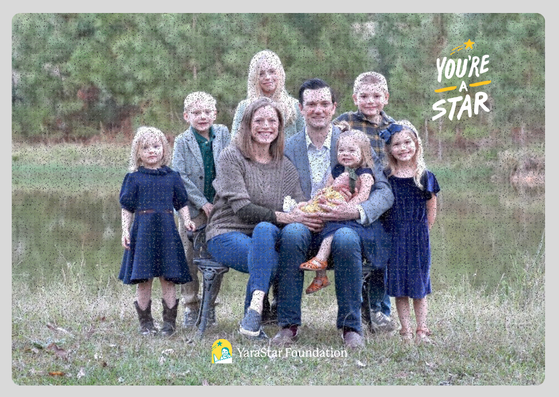
Baby Edith Cradled by Her Adoring Family
What Honest Looks Like
Her mom does not tell the story in a way that makes it sound easier than it was.
"I was overwhelmed at first. And I expected to be. I struggle with guilt and frustration when I am not able to perform something all the way."
Her program coach helped her shift the frame: focus on what is going well, not what fell short. Slowly, something changed in the household — not just in Edith's development, but in the culture around it. One of the first significant wins was not a mobility milestone. It was a home where Edith's growth became something everyone participated in and celebrated together.
Before and After
From around three months old, Edith struggled with painful digestive issues that were stressful for the whole family. A simple supplement recommendation from the program team made a significant difference within two weeks — the kind of early win that tells a family they are in the right place.
Speech was limited — she says Dada, Bubu, and what her mom believes is her own name. She has a way of saying "hiiiiii" that her mom describes as super adorable. The intent is already there. The words are forming.
Motor development was delayed, and she worked on it with more joy and determination than her mom had seen in anyone. And she was always watching. She locks onto words in her environment and waits to be told what they mean — most recently the EXIT sign at the pediatrician's office. She loves finding words.
Six months into the program, mobility became her greatest achievement. She went from very limited movement to crawling and creeping. Her physiotherapist was blown away. She now turns pages of books by herself, plays handbells and rhythm sticks on a steady beat, and is starting to pull up. She can engage in play with siblings and friends in ways she simply could not before.
And she is proud of herself. You can see it.
Her mom put it this way:
"I think the program will become increasingly infused into the pulse of our life with Edith — feeling less and less like a chore and more and more like just the way we engage joyfully and fruitfully with one another."
What the Scholarship Meant

For Edith's family, the YaraStar scholarship was not only financial relief. It was something harder to name — someone saying: we see what you are doing, we know what this program is, and we want to add some support to what you are already carrying.
Her family said it this way:
"There are people who know what a gift this program is and who are willing to add some wind and financial resource to our sails. That really means so very much."
YSF does not take credit for Edith's progress. Her family does that work — all seven of them, every day. The scholarship makes sure they can keep going.
They want to watch her grow into pride in herself — to celebrate how extraordinary she is in the way the people around her already do. She is fifteen months old, and she is already cheering other people up when they are having a hard day.
Whatever she becomes, she is already something.
With the support of a YaraStar scholarship, Edith's family can continue the brain development program, focusing on mobility, speech, and the daily work that is already becoming simply the way this family lives. We are honored to walk alongside them.