
When Ojas Found His Forward
Six-year-old Ojas does not begin his mornings the way many children do. His days are structured, intentional, built around movement, repetition, and quiet determination. Autism has shaped his early years — not only in how he communicates, but in how his body organizes itself, how he sleeps, how he understands the world around him.
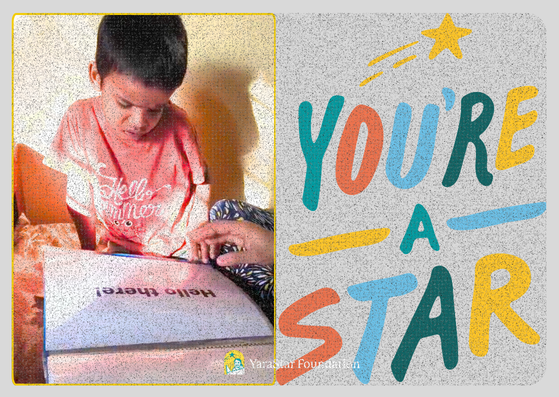
Ojas reading with his mom
There was a time when Ojas could not tell his parents if he was hungry or in pain. Nights were restless. Simple instructions felt out of reach. Dressing, feeding, toileting — each required full assistance. His parents learned to watch closely, to interpret sounds and gestures, to anticipate needs before frustration rose.
And beneath all of it, there was another layer: pressure.
Ojas’ family lives in India, where accessing an intensive neurodevelopmental program requires careful sacrifice. Every decision is weighed. Every expense considered. His mother gives eight hours a day to implementing his program at home. His father, after long workdays, adds his two hours faithfully. Their lives revolve around giving Ojas the best chance possible.
The Shift Toward Possibility
Before beginning this path, Ojas was non-verbal and struggled with basic independence. Crawling — something most children do instinctively — had never happened for him as a baby.
But something changed when his parents committed fully to a structured neurodevelopmental program.
They had already been working at home for a year before their first in-person evaluation. They came prepared. They believed in the process. And over six months, they followed every sequence consistently.
At their evaluation in Bangalore, the staff saw what commitment had quietly been building.
Ojas crawled.
Not prompted. Not forced. He demonstrated it on his own.
He also began running — twenty meters without stopping. For a child who once struggled with coordination and stamina, this was not small. It was momentum.
He moved forward in mobility levels. His vision improved. And then came a reading breakthrough.
As his coach shared:
“He got a reading victory. He went from Level VI to Level VII in vision. He can read more than 100 words easily. He had never crawled as a baby but he demonstrated crawling this time when he was evaluated by staff in November 2025. He has started running and can run 20 meters non stop.”
More than 100 words.
For a child once unable to communicate basic needs, words are more than academics. They are bridges.
Discipline at Home
Ojas’ days now follow a steady rhythm — breathwork to strengthen his lungs, reading sessions that stretch his understanding, tactile and oral activities that organize his senses, and movement programs that build stamina through crawling, patterning, and running.
Day after day, his parents quietly weave this work into the fabric of their home.
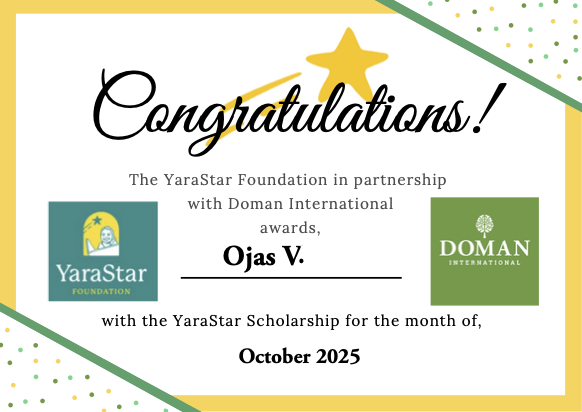
The family’s goal in applying for a YaraStar scholarship was simple: sustainability.
The scholarship allowed them to continue the advanced program with full focus — without the constant tension of wondering whether they can maintain it long-term due to the high cost.
Looking Ahead
Ojas’ future is not defined by a label.
His parents believe in what they are seeing — a boy who is stronger, more aware, more coordinated, and increasingly capable of learning.
They are not asking for instant transformation. They are committed to steady work.
And Ojas?
He is moving forward — sometimes on his knees across a mat, sometimes across a page filled with words, sometimes twenty meters at a time.
Forward is forward.
And for this family, that is everything.